

Proper bite alignment is essential for maintaining healthy teeth, jaws, and overall oral comfort. Even small bite imbalances can lead to jaw pain, headaches, worn teeth, and complications with restorations. At our practice, we use T-Scan technology to provide precise occlusal analysis and deliver customized bite adjustments for optimal dental function.
T-Scan is an advanced digital occlusal analysis system that measures bite force and timing with exceptional accuracy. Unlike traditional methods that rely on articulating paper or patient feedback, T-Scan provides a dynamic, computerized map of how your teeth meet when you bite, showing which areas receive the most pressure and how forces are distributed across the bite.
An uneven bite can contribute to a variety of dental and muscular issues, including:
By identifying and correcting bite imbalances early, T-Scan technology helps prevent long-term dental problems and improves overall oral function.
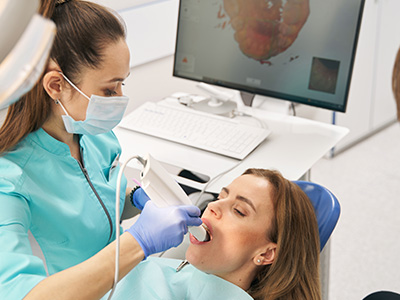
During a T-Scan evaluation, a thin sensor is placed between your teeth while you bite and chew. The sensor collects data on:
This data is displayed as a dynamic, color-coded map that allows your dentist to pinpoint exact areas of imbalance. Adjustments can then be made precisely to improve bite alignment, protect teeth and restorations, and reduce strain on jaw muscles.
T-Scan technology is useful for patients who:
If you experience jaw discomfort, uneven wear, or just want to ensure your bite is functioning optimally, T-Scan technology can provide the insights needed for lasting results. Contact our office today to schedule your occlusal balancing consultation and experience the precision of digital bite analysis.


T-Scan is a digital occlusal analysis system that records the timing and force of tooth contacts during biting and chewing. It uses a thin, electronic sensor and proprietary software to produce a dynamic, color-coded map of how forces are distributed across the bite. This objective data reveals premature contacts and imbalanced forces that are not always apparent with traditional methods.
At Vaccaro Aesthetic and Family Dentistry we incorporate T-Scan into clinical evaluations to improve precision when adjusting occlusion and planning restorative care. The technology supports data-driven decisions that protect natural teeth and help restorations perform predictably. Patients typically find the process minimally invasive and informative.
Unlike articulating paper, which only shows the location of contacts, T-Scan measures both the timing and magnitude of forces so clinicians can see which teeth strike first and how pressure shifts across the bite. Traditional methods rely heavily on static marks and subjective interpretation, while T-Scan delivers dynamic, time-based information that highlights problematic sequences of contact. This difference makes it possible to identify issues such as early contacts that lead to overload and wear.
T-Scan also allows clinicians to compare pre- and post-adjustment recordings to confirm that interventions produced the intended changes. The visual and numeric output improves communication with patients and supports predictable treatment planning. For complex cases involving multiple restorations or full-mouth rehabilitation, T-Scan provides a reproducible record that complements clinical judgment.
Patients who experience jaw pain, frequent headaches, or unexplained tooth sensitivity may benefit from an occlusal analysis with T-Scan. It is particularly helpful for people who have new crowns, bridges, implants, or orthodontic work because restorations that do not share load evenly can fail prematurely. T-Scan is also useful for preventive maintenance when clinicians want to monitor bite changes over time.
We recommend an evaluation for patients reporting TMJ problems, uneven tooth wear, or recent changes in how their bite feels during chewing. It is appropriate for adults and for many adolescents when clinically indicated, and it integrates easily into routine restorative or diagnostic visits. Your dentist will review your medical and dental history to determine whether T-Scan is the right adjunctive tool for your care.
During a T-Scan evaluation a thin disposable sensor is placed between the teeth while the patient performs specific biting and jaw movements. The sensor captures a sequence of contact events that the software translates into color-coded force maps and timing graphs in real time. These recordings let the clinician isolate premature contacts, shifting force centers, and areas of excessive load.
After analyzing the data the dentist performs targeted occlusal adjustments or documents findings to guide restorative procedures. The adjustments are conservative and focused on redistributing forces rather than removing excessive tooth structure unnecessarily. A follow-up T-Scan recording confirms the effectiveness of the adjustments and helps plan any further care.
A standard T-Scan appointment typically adds only a few minutes to an exam or restorative visit and usually takes less than 15 minutes for a complete recording and review. Because the sensor is thin and flexible the procedure is generally comfortable and noninvasive for patients. No anesthesia is required unless adjustments are performed that would normally need local anesthetic.
Any occlusal adjustments are conservative and performed with patient comfort in mind, often using small polishing instruments to refine contacts. Patients may notice immediate changes in how their bite feels and in chewing comfort after adjustments. Your clinician will explain what was observed and discuss any recommended follow-up steps.
Yes, T-Scan can be a valuable diagnostic tool in managing TMJ disorders and related headaches by identifying occlusal imbalances that contribute to muscular strain. When one side of the bite bears excessive force or when contacts occur in a distracting sequence, jaw muscles can compensate and produce pain or tension. By revealing the timing and magnitude of these forces, T-Scan helps clinicians target adjustments to reduce parafunctional loading.
Occlusal balancing is often part of a comprehensive TMJ treatment plan that may include physical therapy, oral appliances, and behavioral strategies to reduce clenching or grinding. T-Scan findings inform the design and equilibration of night guards and other appliances so they provide balanced support. Patients generally experience improved comfort when occlusal contributors to muscle strain are addressed alongside other therapies.
Restorations such as crowns, bridges, and implants require even distribution of occlusal forces to function well over time, and T-Scan helps ensure those forces are shared appropriately. An undetected high contact on a new crown or implant can lead to mobility, fracture, or discomfort, so objective force mapping at the time of delivery is critical. T-Scan allows immediate verification and adjustment before problems develop.
For implant-supported restorations T-Scan data can be used to minimize overload on the implant-abutment complex and surrounding bone. When multiple restorations are placed, clinicians use the technology to coordinate occlusion across the arch and maintain harmonious contacts. This attention to force management supports long-term durability and patient comfort with prosthetic treatment.
T-Scan integrates smoothly with other digital dentistry tools such as intraoral scanners, CBCT imaging, and CAD/CAM workflows to create a comprehensive diagnostic picture. Combining force data with three-dimensional images and digital impressions improves treatment planning for complex restorative and orthodontic cases. This multidisciplinary approach supports more predictable outcomes and efficient appointments.
In restorative cases the practice may use T-Scan recordings alongside digital design software to refine final prosthetic occlusion before fabrication or during try-in appointments. The data also enhances communication between clinicians and dental laboratories by providing objective expectations for contact patterns. Together these technologies reduce guesswork and help achieve precise functional and aesthetic results.
T-Scan is a clinically validated instrument that provides repeatable, quantitative information about occlusal timing and force distribution, improving on subjective methods. While no diagnostic tool is a standalone solution, T-Scan adds an objective layer of data that complements clinical examination and patient history. Its high temporal and force resolution enables clinicians to make targeted adjustments with greater confidence.
Results depend on proper technique, patient cooperation, and clinician interpretation, so skilled practitioners are essential for translating data into effective treatment. At the practice clinicians use T-Scan as part of a holistic assessment to ensure findings align with symptoms and restorative goals. When used correctly, patients can expect clearer explanations, measurable pre- and post-treatment comparisons, and more predictable functional outcomes.
The frequency of bite checks with T-Scan varies based on individual risk factors, recent dental work, and symptoms rather than a fixed schedule. Patients who receive new restorations, begin orthodontic treatment, or experience changes in jaw comfort may benefit from an evaluation shortly after treatment and again during follow-up. For routine maintenance, periodic checks during regular dental visits help detect emerging imbalances before they cause significant problems.
Your dentist at Vaccaro Aesthetic and Family Dentistry will recommend an interval tailored to your needs and the specifics of any restorative or appliance therapy you have. Proactive monitoring is particularly helpful for patients with bruxism, extensive dental work, or a history of TMJ symptoms. Regular assessments with objective tools like T-Scan support long-term oral health and protect investments in dental care.

Ready to book your next dental visit or learn more about our services?
Getting in touch with Vaccaro Aesthetic and Family Dentistry is quick and easy. Our friendly team is here to help with scheduling, answering questions about treatments, and addressing any concerns. Whether by phone or our convenient online form, we make connecting with us easy. Take the first step toward a healthier, more confident smile—contact us today and experience personalized dental care that truly makes a difference.

Back to top
